
Charlevoix Projected Versus Actual Release
Michigan does not publish one universal “projected release date” for every person. The right label changes with the custody system. For a state prisoner, OTIS may show an Earliest Release Date, a Parole Board Jurisdiction Date, a Maximum Date, and, after release, a Date Paroled. The earliest date marks potential Board authority after the minimum term. It is not a promise. The maximum is the current outside sentence calculation, while Date Paroled records an actual state-prison exit into parole status.
Charlevoix County jail records work differently. A sentenced jail inmate’s date comes from the signed court commitment, credited days, applicable county good time, any forfeiture or restoration, and other holds. A person held before trial has no sentenced release schedule. Bond or recognizance may authorize release, but the jail must still process the exit and check for holds. A dismissal in one case also may coexist with another case.
Find Charlevoix Release Date Records
Classify the case before searching. OTIS expressly excludes county-jail-only sentences, and the Sheriff does not calculate an MDOC prison date. A Charlevoix jail disappearance may also reflect transfer to MDOC, another county, ICE, or the United States Marshals Service. The destination field in the jail record determines which system should be checked next.
- For a county case, check MiCOURT for the commitment, bond order, sentence, jail credit, or later correction. Search 90th District for misdemeanors and the early stages of a felony; search 33rd Circuit for final felony disposition and sentence.
- Call the Charlevoix County jail at 231-547-4461 for current custody and transaction-specific timing. Ask whether the event is community release or transfer.
- For a county sentence, request the commitment, jail-credit calculation, inmate release form, date and time, release type, and destination through the Sheriff’s official FOIA form.
- For a Michigan prison sentence, open MDOC OTIS. Search by MDOC number when known, or by name with identity filters.
- Read Earliest Release, Maximum Date, Date Paroled, status, and location together. Recheck the record because lawful sentence changes can move future dates.
A focused records request is better than asking when someone “should get out.” It seeks the existing records on which the calculation rests. The Charlevoix County released inmates search provides the wider path when the custody system is not yet known.
Charlevoix OTIS Sentence Labels
OTIS contains Michigan prisoners, parolees, probationers under MDOC supervision, and recent discharges within the public display window. Search requires at least a last name or MDOC number. The number is unique and gives the cleanest match. A name search can be narrowed by age, gender, race, and offender status. To find a recent discharge, include the DISCHRG status rather than limiting results to current prisoners.
The sentence labels answer different questions. Parole Board Jurisdiction or Earliest Release identifies the first possible eligibility point. A Board grant is still followed by release planning. Maximum Date is based on the current controlling calculation. Date Paroled is the actual day MDOC reports that the person left prison or entered parole status. PAROLE confirms community supervision, while DISCHRG confirms the end of MDOC jurisdiction for that sentence.
The official OTIS status and sentence reference illustrates the terms used by Michigan.
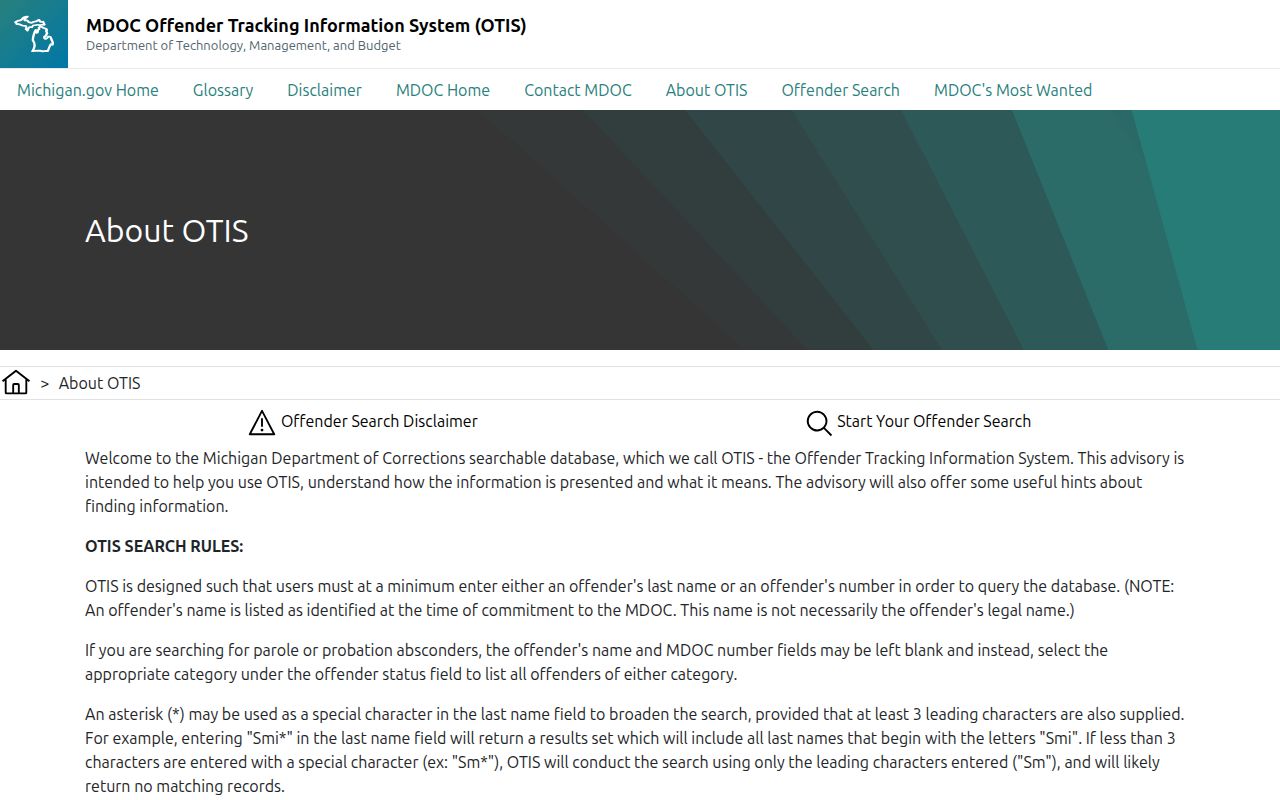
The display should be read as a dated agency calculation, not converted into a generic guaranteed-release field.
Note: OTIS keeps recent discharges online for three years, so older release proof may require MDOC records or the sentencing court.
Michigan Release Date Sentencing Rules
Michigan truth in sentencing must not be reduced to an “85 percent rule.” For covered crimes, the key rule is service of the full judicial minimum in a secure correctional facility before parole eligibility. The regime applies to specified assaultive crimes committed on or after December 15, 1998, and other covered crimes committed on or after December 15, 2000. It removed good-time and disciplinary credits against the minimum in those cases. Disciplinary time can still affect the Board’s review.
MDOC’s truth-in-sentencing explanation supplies the current state framework. MCL 791.233 and 791.234 govern parole authority and eligibility. Sentence and offense dates matter. A person with an older credit-eligible sentence may fall under a legacy regime, but those credits cannot be applied merely because a present-day search shows a future maximum date.
- Minimum term
- The judicial term generally served before parole eligibility in a covered state case.
- Earliest release
- The first potential Board-jurisdiction point, not an exit promise.
- Maximum date
- The current outside calculation on the controlling sentence.
- Date paroled
- The actual prison-exit date reported by MDOC.
Charlevoix Parole Date Sequence
Parole timing has four separate stages. Eligibility comes first, usually when the minimum term and applicable legal requirements are met. The Board then considers the file and can grant, deny, or defer. A grant goes to the Parole Release Unit for placement, notices, conditions, and a release plan. Actual exit is shown later by Date Paroled and parole status. Combining these stages into one projected date creates false certainty.
The Board consideration process often begins months before eligibility. That lead time is administrative review, not a shorter sentence. Michigan also does not publish a simple person-level calendar and outcome database for each routine case. Public hearing notices tend to cover special lifer-law, commutation, and pardon matters. OTIS remains the practical public source for the later status and actual parole date, while a person-specific Board record may require an MDOC request.
A maximum date has a different role. If parole does not occur, the maximum is the potential outside discharge point based on the current controlling calculation. A future maximum can still change after resentencing, a court correction, consecutive-term analysis, or a lawful credit decision. A past maximum paired with DISCHRG is much stronger completion evidence.
Charlevoix County Jail Good Time
A county jail term does not use OTIS’s state-prison fields. Michigan law provides a separate county rule. MCL 51.282(2) provides one day of reduction for each six days for a county jail prisoner with no rule violations, subject to the Sheriff’s forfeiture and restoration authority. That statutory rule is only one input. The signed commitment, jail credit, concurrent or consecutive terms, violations, and other holds still control a real case.
For example, a county commitment is not solved by typing the name into OTIS. Start with the court’s signed order and credited days. Then obtain the Sheriff-confirmed good-time treatment and check for any forfeiture or hold. The inmate release form supplies the actual transaction. Applying a rough fraction without those records can produce the wrong day and can mistake a transfer for release to the community.
No Charlevoix-specific published weekend or holiday acceleration rule was located. There is no sound basis for assuming that a Sunday date becomes a Friday release, or that another county’s practice applies. The jail should confirm the specific computation and processing plan.
Why Charlevoix Release Dates Change
Future dates can move for reasons found in the sentence, custody record, or later legal event. The source of the date should determine the source of the correction. Court-derived sentence facts go to the sentencing court. State custody calculations and supervision details go to MDOC. County jail computation questions go to the Sheriff with the commitment in hand.
| Factor | Possible effect | Best verification |
|---|---|---|
| Parole grant, denial, or deferral | Changes whether release occurs at or after eligibility | Board record, OTIS, then Date Paroled |
| Discipline or credit decision | May affect eligible older state sentences or county good time | Applicable statute and agency time record |
| Jail credit or resentencing | Changes the time calculation | Corrected court order and agency record |
| Consecutive sentence | Extends the controlling term | Judgment and sentence detail |
| Detainer or outside hold | Can turn expected community release into transfer | Release destination and receiving agency |
| New conviction or court correction | Can alter the displayed dates | Court docket and updated agency calculation |
Charlevoix Date Calculation Limits
The most important local quirk is the absence of a Charlevoix-specific online calculator or published weekend-release policy. The county jail’s transaction must be reconstructed from primary records. The commitment shows the sentence. The jail-credit calculation shows time credited. The Sheriff’s release form shows the actual date, time, type, and destination. Michigan’s GS11 schedule describes those records but does not create a public calculator.
This is especially important when a release date is near. A court order may authorize release while an outside warrant or detainer keeps the person in custody for transfer. Conversely, a person can leave the building for MDOC placement even though no community release occurred. The correct phrase is “released from Charlevoix County custody” only when the transaction and destination support it.
Confirm Charlevoix Actual Release
MI-VINE can report a participating agency’s release or transfer event, but it does not provide the full legal reason or destination. For a pending county custody change, use the Sheriff-linked county endpoint and confirm time-sensitive facts by phone. For a state prisoner, recheck OTIS for Date Paroled and the new status. A future Maximum Date alone is not proof that the person is out.
Release notifications are useful when their limits are clear. The VINE Inmate Check explains identity matching and event registration for a named person. Final documentary proof remains the originating agency’s release form or MDOC status record, paired with the court order when the legal basis matters.
When a displayed sentence fact appears wrong, route the issue to its source. MDOC says most OTIS sentence and conviction facts come from court records, so a court-origin error should be addressed through the sentencing court. Supervision and absconder errors go to the assigned field office. MDOC can update its display when directed by the court or supervising agent. Keep the old result, correction request, and updated result with observation dates so the change is clear.