
Charlevoix Parole and Probation
Parole is conditional release from a Michigan prison before the maximum discharge date. The Michigan Parole Board grants parole, and the Michigan Department of Corrections, or MDOC, supervises the person in the community. Probation is a court sentence. It may follow a county jail term, or it may begin without any prison term. MDOC supervises many felony probation cases, while court probation contacts remain tied to the court that issued the order.
A person can be outside the Charlevoix County jail and still be under legal supervision. Physical release and discharge are separate events. Discharge means the term of MDOC jurisdiction or court supervision has ended. A person shown as PAROLE in OTIS has left prison but remains under MDOC authority. A PROB result means MDOC-supervised probation; it does not establish that the person served a prison sentence.
| Point | Parole | Probation |
|---|---|---|
| Legal source | Michigan Parole Board release from prison | Court-ordered community sentence |
| Main verification | OTIS status, Date Paroled, supervising location | OTIS when MDOC supervises, plus the sentencing court |
| Who retains authority | MDOC until discharge | The court, with the assigned supervision agency |
| End point | Parole discharge or maximum discharge | Probation discharge or court termination order |
- Parole
- Conditional community release from state prison.
- Probation
- A community sentence imposed by a court.
- Discharge
- The formal end of the supervision term.
- Absconder
- A person MDOC reports as having failed to remain in contact or comply and wanted for return to supervision.
Check Charlevoix Supervision Status
The official starting point for a state-supervised Charlevoix County person is MDOC OTIS. OTIS covers current prisoners, parolees, probationers under MDOC supervision, and people within its three-year post-discharge display window. It does not cover a county-jail-only sentence. Search with the MDOC number when possible because that number is unique. A name search should be checked against birth date, aliases, physical details, sentence, and county before relying on the result.
- Open OTIS and search by MDOC number or at least the last name. Use age, status, and other filters to narrow common names.
- Open the matching record only after comparing identity details. Read status, location, sentence, parole date, and discharge information together.
- If the status is PAROLE or PROB, note the supervising location. Do not treat the displayed office as the person’s present physical location.
- Use the MDOC Region 2 office directory to confirm the office and its current contact details.
- For probation, check the Charlevoix court record as well. MiCOURT can show the order and later discharge event, while the clerk’s file controls.
For a recent county-jail exit, the Sheriff release form answers when custody ended and whether the event was release or transfer. It does not by itself answer whether the person is on parole or probation. The broader released-person verification path is explained on the Charlevoix County released inmates home page.
Note: OTIS normally removes a record three years after discharge, so no result does not disprove an older supervision term.
Charlevoix Supervision Office Records
Charlevoix County is part of MDOC Field Operations Region 2. The official directory lists the Charlevoix County Parole/Probation Office at the same State Street address used by the local courts. A person connected to the county may still report elsewhere, so the supervising location in OTIS should be checked before calling. The field office can address agency-verifiable supervision information and errors tied to current parole or probation status.
Charlevoix County Parole/Probation Office301 State Street
Charlevoix, MI 49720
231-547-7222
The Michigan Parole Board is the sole paroling authority for felony offenders committed to MDOC. Board inquiries use the official Parole Board information page. Eligibility is not a grant. A grant also starts release planning; it is not proof the person left prison that day. The Parole Release Unit coordinates placement, the parole date, term, conditions, and required notices before actual release.
The official directory screenshot shows how MDOC organizes field-office contacts. Review the MDOC office directory source before using an address from an older record.
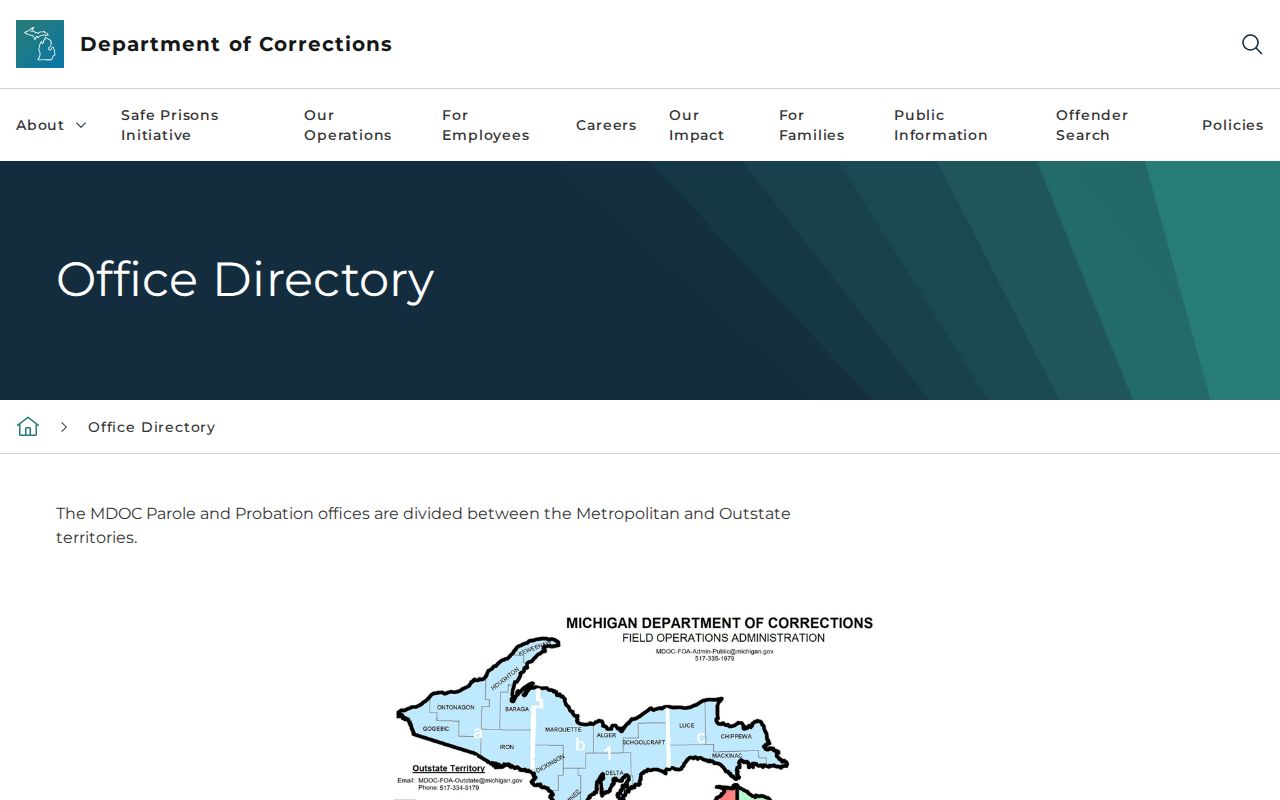
The directory is the correct bridge from an OTIS supervision location to the office assigned to that case.
Charlevoix Absconder Status Checks
An absconder status is not the same as current jail custody. MDOC uses absconder codes when a supervised person has failed to remain in contact or comply and is wanted for return to supervision. The OTIS location for an absconder reflects the last supervising office, not a current street address or detention site. A separate arrest, warrant, or hold may exist, but it must be confirmed through the agency that owns that record.
MDOC directs location tips to local law enforcement or its Absconder/Escapee Tip Line at 517-755-0855. The research found no official public Charlevoix County warrant or most-wanted database. MiCOURT can supply case events, and OTIS can supply the MDOC supervision code. Neither should be replaced with an unofficial warrant site. When a status appears wrong, supervision and absconder errors go first to the supervising office. Court-derived sentence facts go to the sentencing court.
Charlevoix Supervision Discharge Records
Supervision ends through a formal agency or court event. In OTIS, DISCHRG means MDOC reports that jurisdiction for the sentence ended. The status can follow successful parole or probation completion, maximum-date discharge without parole, or another defined discharge path. A probation-discharge order in MiCOURT shows the end of that court supervision. It does not establish the earlier date when someone physically left jail.
Michigan’s public OTIS window is limited. A recent discharge may remain visible for three years, while an older record may require a focused MDOC records request or the sentencing court file. A confirmed set-aside can also cause MDOC to remove an OTIS entry. Because the source and date matter, record the exact status, the agency, and the observation date instead of reducing the result to “free” or “not supervised.”
Charlevoix Parole Decision Records
Michigan does not publish a routine name-by-name calendar for every parole interview or a public database of all person-level decisions. Public notices are more often tied to lifer-law, commutation, and pardon hearings. A routine consideration can occur without a public hearing. The Board can grant, deny, or defer consideration, and a grant then moves into release planning. None of those events should be labeled as an actual prison exit without a later Date Paroled.
OTIS is the most direct public check for the later status. A person-specific Board record may also be requested from MDOC under FOIA, subject to exemptions. Quarterly Board reports are aggregate and can explain grant, denial, deferral, and guideline patterns, but they do not verify one person. The official legislative reports collection should therefore be used for context, not identity confirmation.
Charlevoix Reentry After Parole
Networks Northwest documents a local path for eligible people recently released from state prison. Its OS Reentry program serves the Charlevoix area through parole-agent referral. Listed support includes identification help, hygiene kits, transportation help, and connections to health and behavioral-health services. These are practical needs that can affect a person’s first days under supervision.
The program is not a universal benefit for every county-jail release. Eligibility and referral must come through the parole channel described by the provider. The official OS Reentry information lists regional contact Christal Frost Anderson at 231-357-1670. A parole agent remains the correct source for whether a specific person can be referred.
Note: County-jail release, MDOC parole, and eligibility for a parole-referred service are three separate facts that require separate confirmation.
Charlevoix Release Property Forms
Post-release questions are not limited to supervision status. Michigan’s local-government retention schedule, GS11, specifically recognizes property intake and release records. It also identifies property-release forms within an inmate jacket. A person disputing returned property or the recorded exit transaction can ask the Sheriff for these named records instead of making a broad request with no document type.
GS11 item 11.212 keeps property intake and release records through the end of the calendar year plus one year. Item 11.210 describes inmate jackets, which can contain property forms and are retained until release plus ten years. These periods do not promise public disclosure in every case. They show why a focused request can still reach an underlying Charlevoix County jail record after an online custody result changes.
Charlevoix Custody Care Coordination
Northern Lakes Community Mental Health describes a distinct local continuity-of-care process. Its Charlevoix first-responder guide says the Sheriff and jail provide a daily current-inmate roster for review of existing clients. That feed is operational and nonpublic. It is not a citizen search tool, yet it documents how care staff may coordinate around a known client’s custody transition.
The distinction matters. Public users should not expect access to that daily roster or treat it as a release list. A person seeking support for an existing client should use the authorized care channel. A person verifying parole or probation should use OTIS, the field office, and the court record. The local behavioral-intervention guide supports the coordination fact, not public access to the underlying roster.