
Federal BOP Releases and Charlevoix
The Facility Map identifies the Federal Bureau of Prisons as a nationwide system, not a physical Charlevoix County jail or local prison. No BOP institution was found in Charlevoix County. The federal route still matters when a county release or transfer record names BOP, a federal register number, a federal sentence, or another federal custodian.
BOP operates prisons for federal custody. It does not replace the Charlevoix County Sheriff’s release record, Michigan OTIS, ICE’s detainee locator, or the federal docket. A person may leave the county jail under a federal writ or transfer and remain in custody. That departure is not community release. Likewise, a person released from BOP can remain subject to federal supervised release imposed by the court.
BOP locator records also include some people who were held without ultimately serving a federal sentence, such as certain pretrial detainees, material witnesses, or people held for civil contempt. A locator match is evidence of a BOP record, not proof of conviction.
Search Federal BOP Release Records
The BOP Inmate Locator covers federal inmate records from 1982 forward. Search by a unique number when one is known. Number options include a BOP register number and identifiers associated with DCDC, FBI, or INS records. A name search can be narrowed using age, race, and sex.
- Choose the locator’s number search when a register or other supported identifier is known.
- Otherwise enter the legal name and use available identity filters to reduce same-name results.
- Compare the register number, age, race, and sex before relying on a match.
- Read the release date and listed location or status together.
- If the date is past and no BOP facility is listed, check the federal court record for the release order and any supervised-release term.
The locator’s record explanation states that a past date with no listed facility means the person was released on the shown date and is no longer in BOP custody. That conclusion is limited to BOP. It does not rule out another jurisdiction, later custody, or a term of federal supervision in the community.
Keep the search result tied to its observation date. A future date is not an actual exit, and federal calculations can change. The research specifically notes First Step Act recalculations as one reason. The strongest completed-release statement pairs a past BOP date and no current BOP facility with the federal court record, which can show the controlling order and any supervision imposed after prison.
Note: Use the register number when possible because it identifies the federal record more precisely than a name alone.
Federal BOP Release Result Fields
BOP results provide a compact identity and custody record. Read the fields as a unit, especially when several people share a name. The locator does not provide the full federal case history or every change that may affect a future date.
| BOP field | What it supports |
|---|---|
| Name | The identity used in the BOP record, subject to comparison with the court case. |
| Register number | The strongest public identifier for the specific BOP record. |
| Age, race, and sex | Narrowing details for separating people with similar names. |
| Release date | A past or future BOP date that must be read with current location and status. |
| Location or status | The listed BOP institution or indication that the person is no longer held in a BOP facility. |
A future release date can change. The research notes that First Step Act recalculations may affect displayed dates. Court action, sentence correction, or other lawful changes may also alter the larger case picture. Date every observation and return to the locator when the timing is still prospective.
View the Federal BOP Locator
The official BOP search screen shown below is the proper federal lookup route when a Charlevoix County record points to Bureau of Prisons custody.
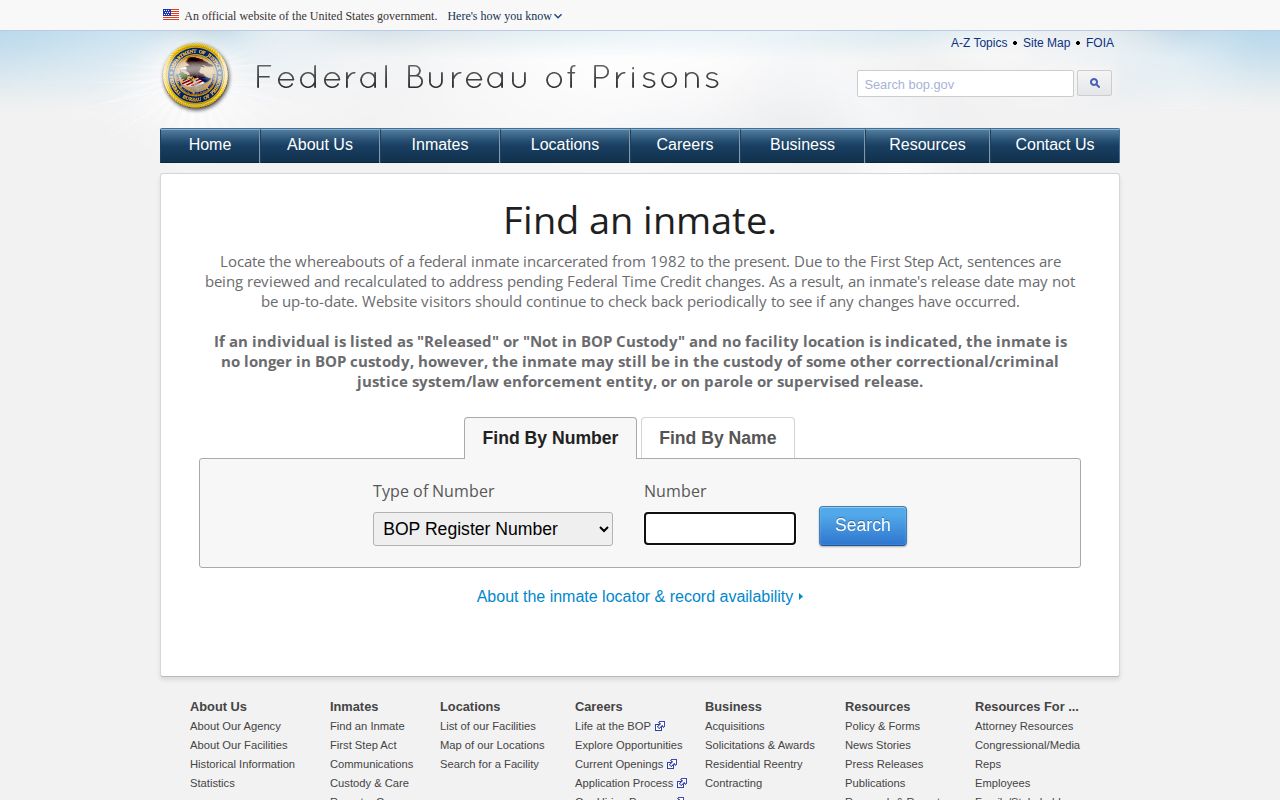
The screen supports number and name searches; the resulting federal record should be matched to the court case and not confused with a Charlevoix jail record.
Where Federal BOP Releases Go
A person leaving a BOP institution may return to the community and begin federal supervised release. Another person may move to a different jurisdiction or custodian. The BOP locator answers whether the person remains in BOP custody and supplies its recorded release date. It does not state that no other agency holds the person.
| Federal finding | Meaning | Required follow-up |
|---|---|---|
| Past release date, no BOP facility | The person left BOP custody on the listed date. | Check the federal docket for the release order and supervised-release terms. |
| Current BOP location | The person remains assigned within BOP custody. | Read the federal case and current locator record. |
| County record says USMS transfer | The person moved into the federal prisoner process. | Use the federal docket and the relevant USMS district before BOP designation. |
| County record says ICE | The departure may be an immigration custody transfer. | Use ICE ODLS and request the Sheriff destination notation. |
The same event can look different in each system. The Sheriff can document the time Charlevoix custody ended. USMS can be involved before a BOP designation. BOP documents its own custody. The federal court explains detention, sentence, release, and supervision orders.
Federal Court Confirms BOP Release
The federal docket or clerk is the companion source for a BOP locator result. It can explain the underlying detention order, judgment, sentence, release order, and supervised-release term. A past BOP date does not display all of those legal events.
Use the name and federal case number when available. Match the BOP register number and identity details to the court record. If a future date changes, the docket may show resentencing or another order, while BOP’s current calculation remains the source for its displayed custody date.
For records before 1982, BOP directs researchers toward archival sources, including the National Archives. A missing modern locator result for an older case should not be taken as proof that federal custody never occurred.
Federal BOP Records Path
The locator is the public first step for records from 1982 onward. For a documentary answer, preserve the register number, observed release date, and result date. Then identify the federal case and request the specific court order or record needed. Broad requests can blur different stages of federal custody.
Federal Bureau of Prisons
Search federal records from 1982 forward by supported identifier or name.
BOP Record Explanation
Interpret release dates and understand limits in the locator data.
The BOP page is a system page because there is no local BOP facility to contact in Charlevoix County. Do not substitute the county jail phone for a nationwide federal record. Use the Charlevoix Sheriff only when confirming the local departure or transfer notation that led into federal custody.
If the person was held before sentence, begin with the federal docket and the relevant USMS district. USMS manages federal pretrial prisoners through a changing network and has no comprehensive public released-person locator comparable to BOP’s. After BOP designation, the BOP register number and locator become the clearer custody path. The sequence matters because a county transfer to USMS may occur well before any BOP location appears.
Separate Federal and Charlevoix Records
The Charlevoix County released-inmate search begins by classifying the custody episode. A county-jail booking belongs first with VINE, the Sheriff, and MiCOURT. A Michigan prison case belongs with OTIS and MDOC. A federal sentence belongs with BOP and the federal court. An immigration case belongs with ICE ODLS. A federal pretrial prisoner may be managed by USMS before BOP designation.
This separation prevents a transfer from being mislabeled. If the Charlevoix jail says a person left for USMS, the physical county episode ended, but federal custody continued. If the BOP locator later shows a past release date and no facility, the person left BOP on that date. These are two distinct events and may be months or years apart.
A federal locator miss also requires restraint. Check name format, supported identifiers, and whether the record predates 1982. A person may have remained in USMS-managed pretrial custody without a public BOP release path, or the case may belong to ICE rather than BOP. The federal docket is the common legal record when the correct custodian is unclear.
- Designation
- Assignment of a federal prisoner to a BOP institution after the relevant federal process.
- Supervised release
- Court-ordered community supervision that may follow physical release from federal prison.
- Transfer
- A move between custodians or facilities, not release to the community.
- Register number
- The unique public number used to identify a BOP inmate record.