
Charlevoix Released Mugshot Records
A booking photograph is made during intake. Release from the jail does not erase that event or make the image current. Michigan treats government-held photographs within the broad class of public records, but access still depends on the Freedom of Information Act, exemptions, redaction, and the status of the case. A juvenile, sealed, nonpublic, or set-aside matter can require different treatment.
The photograph also proves less than many readers assume. It does not establish conviction. It does not show whether the case was dismissed, whether bond was posted, whether a sentence was completed, or whether another custodian received the person. Current release status needs the Sheriff release record, MI-VINE event, court disposition, or the appropriate state or federal source.
Charlevoix Released Mugshot Sources
The available channels differ by agency and custody system. Charlevoix’s official county path is a records request, not a browsable image feed. OTIS can carry a state identity image. VINELink focuses on custody events and cannot be assumed to show a photograph. News archives and commercial reposts may preserve old images, but they are not authoritative release records and receive no source links here.
| Channel | Has photo? | How to access |
|---|---|---|
| Charlevoix Sheriff roster or release gallery | No official gallery was found | Do not substitute an unofficial roster |
| Sheriff mobile jail app | No official app was found | Use the official corrections page and records form |
| Sheriff booking record | May contain the county booking photo | Submit a focused FOIA request |
| MDOC OTIS | Often, but not for every record | Search a state prisoner, parolee, probationer, or recent discharge |
| MI-VINE | Varies by agency and interface | Use for identity and custody events, not a promised photo |
| News archive | Sometimes | Check the image date and named original source |
| Commercial repost | Sometimes | Not official; may be stale or miscaptioned |
No Charlevoix Mugshot Gallery
The mandatory county sweep found no Sheriff-hosted current roster, recent-release page, booking-photo gallery, archive, or online publication window. The official Charlevoix County corrections page instead directs users to a county-specific VINELink route. That is a named-person custody and notification channel. It is not a gallery of everyone booked or released.
No official Sheriff inmate app, MobilePatrol listing, app release screen, or roster-photo feature was found either. An app or site using county words in its name is not made official by that branding. The safe test is whether the Sheriff links to it and whether the agency identifies it as its service. As of the research date, the documented online service was VINELink.
The absence also shapes recent-release research. The Charlevoix County 24-Hour Releases route explains why a fixed-window gallery cannot be substituted for the county’s named-person and records-request channels.
The official corrections-page image shows the source actually offered by the county. Open the Sheriff corrections source to verify the current links.
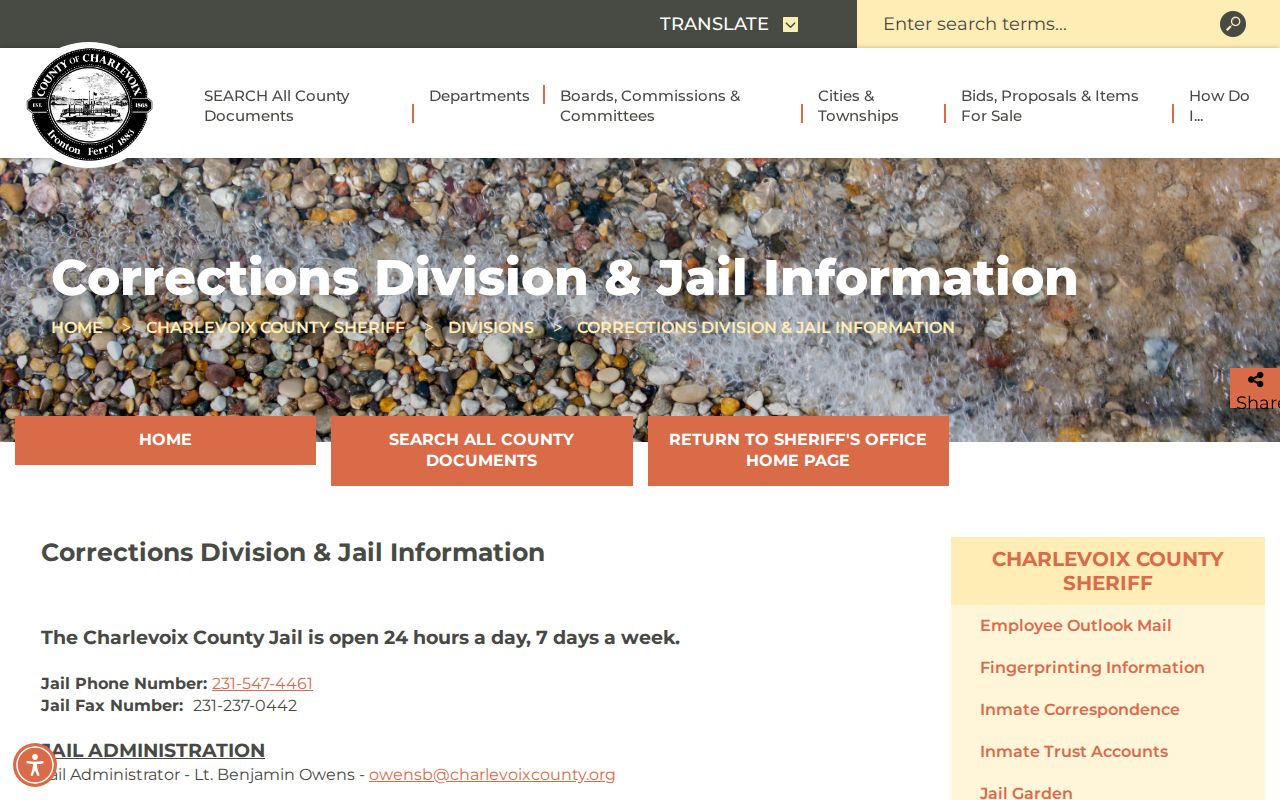
The page supports the absence of a gallery and points the search toward official custody information rather than an unofficial photo archive.
Request Charlevoix Booking Photos
The Sheriff’s FOIA form is the strongest county source for an older booking image. Ask for an existing record, not an explanation or a newly created report. Include enough identity and date detail to distinguish the booking. A narrow request also helps the office estimate search and separation work. The Sheriff says the fee varies with the time required to compile responsive documents.
- Open the official Sheriff FOIA form.
- Provide the person’s name, date of birth when known, approximate booking date, and booking or case number if available.
- Ask for the named booking photograph and booking card. If release context matters, also ask for the inmate release form, exact release date and time, release type, and destination.
- Request electronic delivery, releasable segregable portions, and a detailed estimate before costs pass a chosen limit.
- Keep the response with its date, redactions, and source. Pair the image with the court or custody record rather than treating the image as an outcome.
Michigan FOIA generally requires an initial response within five business days and permits a written extension of up to ten business days. That response may grant, deny, grant in part, or require a deposit. It is not always the date of production for a large request. Fees must follow permitted actual work and itemization rules under MCL 15.234.
The Charlevoix County released-inmate search can help identify the right booking and custody episode before the photo request is filed. A case number, date range, and release destination reduce the risk of requesting an image tied to a same-name person.
Note: Send a county-jail photo request to the Sheriff, even when a city police department made the original arrest.
Charlevoix Mugshot Retention Records
Michigan’s GS11 retention schedule supplies the clearest evidence that the underlying county photo can persist after a person disappears from a public interface. Item 11.210 describes the inmate jacket as potentially containing intake records, booking cards, mugshots, sentencing material, property forms, transfer documents, bonds, warrants, and inmate release forms. The jacket is retained until release plus ten years.
That period is a records-retention rule, not an online-gallery term and not a guarantee that each image must be disclosed. The Sheriff still applies FOIA exemptions and redaction. Related daily count summaries may list releases and remain through the end of the calendar year plus one year. Property intake and release records follow a similar calendar-year-plus-one period, while JPIS and midnight counts extend through calendar-year end plus two.
These separate schedules explain why “not online” does not mean “no record.” A dated, document-specific request can reach the agency file even though Charlevoix publishes no photo feed.
Charlevoix State Offender Photos
MDOC OTIS may display a photograph for a state prisoner, parolee, probationer, or recent discharge. It is not the Charlevoix County booking photo unless the Sheriff separately supplied that same image. OTIS also excludes people sentenced only to county jail. Some state records lack an electronically taken photo, and recent discharge entries generally remain public for three years.
Search with the MDOC number when known. Otherwise compare name, birth date, aliases, marks, sentence, county, and status. A photograph can help separate same-name records, but it does not establish current custody by itself. PAROLE means physical prison release with ongoing community supervision. DISCHRG means MDOC jurisdiction has ended for that sentence. The observation date should stay with any image reference.
Charlevoix Mugshots in News Archives
A local or regional news report may reproduce an agency image. The image can outlast the event that led to publication and can be copied without later court or release updates. Before relying on it, identify the publication date, caption, named source agency, and whether the article reports arrest, charging, disposition, or release. Those are different events.
Commercial mugshot and roster sites are less reliable. They may retain old data, omit corrections, or present themselves as county resources. They are not valid evidence of Charlevoix County policy or current custody. No commercial mugshot publisher, data broker, or removal service is linked or endorsed. An official source should control when a caption or status conflicts.
Three dates should be kept distinct: the date the image was made, the date it was published, and the date the related custody event ended. A news page can be accurate about the first two and still say nothing about the third. When a later official record shows dismissal, set-aside, transfer, parole, or discharge, that record should accompany the old image rather than rewriting the image as proof of the later event.
Charlevoix Mugshots After Set-Aside
Michigan’s set-aside process can change official public visibility. Automatic processing began in 2023, while application-based relief uses the current court form and must be filed in each convicting court. Eligibility, waiting periods, caps, and excluded offenses depend on the case. A set-aside makes the conviction nonpublic to the general public while preserving authorized nonpublic access.
MDOC says it removes an OTIS entry after it confirms a set-aside with the court. That can remove the state photo from OTIS. The county jail photo is governed by a separate records system, and a set-aside does not mean the historical custody event never happened. Correction or access questions should go to the court and originating agency, with the certified order when needed.
No enacted Michigan statute specifically banning commercial mugshot publication or creating a statewide pay-to-remove prohibition was located in the current law sweep as of the research date. It would be inaccurate to promise such a remedy. Government disclosure remains subject to FOIA exemptions, redaction, and nonpublic status. The official Michigan Clean Slate information is the proper starting point for current state process details.
Photo corrections follow the source. A wrong county booking image or caption goes to the Sheriff with the booking details. A state photo or OTIS display question goes to MDOC. A court visibility issue starts with the court that entered the order. Commercial or news copies remain outside agency control, so the official corrected record should be preserved even when an older copy stays elsewhere.