
Michigan Corrections Release Scope
The Michigan Department of Corrections operates state prisons and community supervision across Michigan. It is not the Charlevoix County jail. OTIS contains people in MDOC prison, parolees, probationers under MDOC supervision, and people discharged within the public system’s post-discharge window. It does not contain county-jail prisoners or jail-only sentences.
A Charlevoix jail disappearance followed by an OTIS prison location is a transfer into state custody, not community release. The Charlevoix County released-inmate search explains how to pair that state result with the county transfer record. For a state prisoner, physical release may occur through parole before the maximum date. The person remains under MDOC jurisdiction while on parole. Discharge at the maximum date, or after supervision ends, is a separate event.
| MDOC state | Custody meaning | Release meaning |
|---|---|---|
| Prisoner with facility | In MDOC secure custody | Not released to the community |
| PAROLE | Outside prison under MDOC supervision | Physical prison release occurred, sentence remains active |
| PROB | Under circuit-court probation supervised by MDOC | Does not prove a prior prison release |
| DISCHRG | No longer under MDOC jurisdiction for that sentence | Read the discharge reason and earlier parole fields |
Search Michigan Corrections Releases
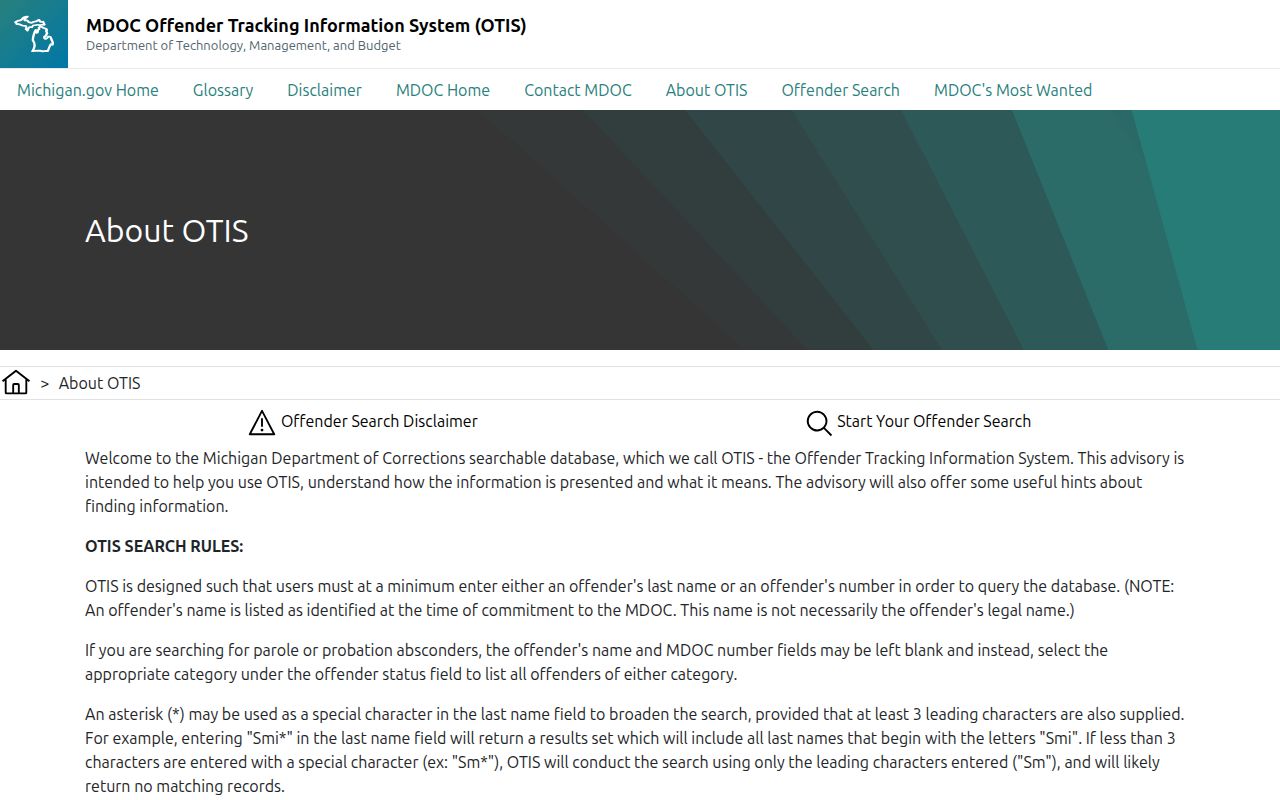
The MDOC OTIS gateway launches the official offender search. An MDOC number is the most precise key because it is unique. If the number is unknown, search by commitment surname and given name. Narrow results with sex, age, race, and offender status. OTIS also supports a surname wildcard after at least three initial letters.
- Start from the official MDOC OTIS information page and open Offender Search.
- Enter the MDOC number, or use the commitment name and available narrowing fields.
- Compare birth date, physical details, aliases, photograph, county, court, and offense before selecting a record.
- Read status, location, sentence entries, Date Paroled, earliest-release information, and maximum date together.
- For a recent discharge, include DISCHRG status rather than limiting the search to current prisoners.
The official OTIS reference explains the system’s status and sentence labels.
Identity matching is essential. OTIS uses the commitment name, which may differ from a current legal name, and a photograph is an identity aid rather than proof of current custody.
Michigan Corrections Release Dates
Michigan does not offer one simple guaranteed projected-release field. The public labels answer different questions. The Parole Board Jurisdiction or Earliest Release Date generally marks the first point when the minimum term has been served and the Board can gain authority. It is eligibility, not an appointment to leave prison.
The Maximum Date or Maximum Discharge Date is the outside controlling date based on the current sentence calculation. Date Paroled is the actual date MDOC reports that the person left prison or camp or entered parole status. A Board grant can still require release planning through the Parole Release Unit before physical exit.
- Earliest Release Date
- The eligibility or Board-jurisdiction point shown for the sentence.
- Date Paroled
- The actual MDOC parole event and prison exit into supervision.
- Maximum Date
- The current outside sentence calculation, subject to lawful changes.
- Discharge
- The end of MDOC jurisdiction for the sentence shown.
Charlevoix Transfers into Michigan Corrections
A felony commitment begins in court and moves through the sending jail. The 33rd Circuit Court judgment establishes the legal sentence. The Charlevoix County jail transfer notation establishes departure from county custody and should name MDOC or another receiving agency. OTIS then identifies state placement.
These are three linked records, not interchangeable ones. A commitment does not prove the date of actual transfer. A Charlevoix release form marked for MDOC does not mean community release. An OTIS prison location confirms the person entered the state system, while later PAROLE or DISCHRG fields answer different release stages.
Note: Prison assignment can change statewide, so the OTIS location should be checked again when current placement matters.
Michigan Corrections Release Supervision
Parole is conditional release from prison under Michigan Parole Board authority. Probation is a court-ordered community sentence and can start without a prison term. OTIS can show both, so the exact status matters. A parolee has physically left prison but remains under state supervision. A probation status alone does not prove that a prison release occurred.
Open the supervising location shown in OTIS and use the MDOC office directory to identify the responsible field office. The local court probation contacts address their own cases and should not be treated as substitutes for the Parole Board or an MDOC field office.
An absconder code means MDOC reports failure to remain in contact or comply and seeks return to supervision. The location shown may be the last supervising office, not a present physical location. It does not prove the person is in the Charlevoix County jail.
Request Michigan Corrections Release Records
OTIS is a public index, not the entire state offender file. A focused MDOC FOIA request can seek existing nonexempt discharge or parole records. Name the person, date of birth, MDOC number, and a tight date range. Identify the discharge certificate, parole or release-date record, basic information sheet, and available offender photograph when each is relevant.
MDOC FOIA CoordinatorP.O. Box 30003
Lansing, MI 48909
Email: MDOC-FOIA@michigan.gov
Phone: 517-335-4194
Fax: 517-335-4193
Michigan FOIA ordinarily permits five business days for the initial response and one extension of up to ten business days. Permitted fees can include actual labor, search, separation, duplication, and postage with itemization. If an estimate exceeds $50, the public body may require a deposit of up to 50 percent. A narrow indexed request is more useful than asking for an entire file.
Michigan Corrections Discharge Visibility
OTIS generally keeps a discharged person visible for three years after discharge. A no-result for an older name cannot establish that the person never served or completed an MDOC sentence. Older information may require a records request, the sentencing court, or another official archive path.
A court set-aside can also change visibility. MDOC says it removes an OTIS record after confirming the set-aside with the court. Certified court copies can be sent to MDOC Records Administration, 4000 Cooper Street, Jackson, MI 49203. Removal from the public index does not mean that the earlier prison or jail exit never occurred.
Death alone does not trigger early OTIS removal. When death occurs under MDOC jurisdiction, MDOC may show it as a discharge reason. That is a custody termination event and must not be described as community release.
Correct Michigan Corrections Release Data
The MDOC FAQ says many OTIS facts come from court records. A court-origin error should first be corrected through the sentencing court. Supervision information, including an absconder status concern, belongs with the responsible parole or probation office. MDOC can update OTIS after a court order or supervising-agent correction.
The source of the disputed field should control the correction route. The Charlevoix jail cannot change an MDOC status. MDOC cannot replace the 33rd Circuit judgment. Likewise, a later OTIS update does not alter the Sheriff’s dated transfer record unless that county transaction itself was wrong.
Michigan Corrections Verification Channels
State release confirmation is strongest when each source answers its own question. Use the official state index for status, the court for the sentence, and MDOC records for a durable document.
| Channel | What it establishes | Limit |
|---|---|---|
| OTIS | Current MDOC status, location, dates, and recent discharge | Not a county-jail archive; post-discharge display is limited |
| Parole Board material | Eligibility process and Board action where published | A grant is not always the physical exit date |
| Field-office directory | Correct supervising location and office route | Does not replace the public status record |
| MDOC FOIA | Existing nonexempt discharge and release documents | Exemptions, fees, and processing apply |
| Sentencing court | Judgment, sentence, and court-origin facts | Does not alone prove prison exit |
The statewide MDOC system is one of several custody channels serving Charlevoix cases. County jail, BOP, ICE, and USMS records remain separate. A record should never be moved from one system’s meaning into another without a documented transfer.